

More Fun with Language
Same-same... but different.
This Substack is about life in Việt Nam from the viewpoint of a 10-year expat who spent his first 60 years in a low-context culture.
Tapping the ❤️ at the top or bottom of the page, or leaving a comment will let me know your thoughts and feelings, which are important and valuable to me. Doing so also helps others find this article. Thank you.
One of my first posts was,
Things expats often misjudge when picking a country to live in, Part 1 - Language
If you haven’t already read it, you may want to open the link in a new tab and read it before diving into this one. If not, this one stands on its own.
Recently, a native Vietnamese who speaks excellent English and whom I had just met, asked me why, after almost 10 years here, I speak only a little tiếng Việt (Vietnamese). I have just enough for basic communication, buying things, and common courtesies, while understanding a bit more than I speak. The short answer is that I just can’t get the tones.
Hell, I can’t even hear the tones much of the time, much less create them.
Plus, when my firs future wife and I first got together, I paid a lot of money for both her and her daughter to take intensive English classes. It was both easier for me and better for them because Vietnamese is only spoken in Vietnam and pockets of Southern California; with English, you can get by almost anywhere. Today, my wife speaks English pretty well, while my daughter borders on fluency — when she wants to.
I’ve always been more comfortable alone than with others, so conversing with random strangers has never been on my things-to-do list; it’s actually on my avoid-at-almost-any-cost list. This, and the fact that I’m much happier using my left brain than my right brain, learning Vietnamese is just not something I‘m willing to put the necessary time into.
Writing the previous sentence is the first time I’ve actually admitted that — even to myself.
If you’re already familiar with tiếng Việt, you will probably nod your head and smile wryly at the following. If you’re NOT familiar, it will help to know that, in the Vietnamese language, there are no letters “f” (they use ph), “j”, or “z”. They more than make up for these by having
3 different letters that look like our “a” (a, ă, and â)
2 letters “d” (d and đ — the one without the bar is pronounced like our “y”)
2 choices for “e” (e and ê)
“i”
3 ways to write an “o” (o, ô, and ơ)
2 forms of “u” (u and ư), and
“y”.
for a total of 29 letters in their alphabet.
Each of those listed above has its sound plus five (5) additional tonal variations noted by adding diphthongs or triphthongs. When you’re reading (or, in my case, looking at) printed Vietnamese, you will see 18 a’s, 12 e’s, 6 i’s, 18 o’s, 12 u’s, and 6 y’s. For example:
ả ê ị ỡ ú ỳ
The good news is that each of them is pronounced only one way and a couple are pronounced the same as another.
The bad news is, I can’t keep even 15% of them straight.
Since it’s a tonal language, pronunciation is meaning — change the way you say a word and you change its meaning. In English, Spanish, French, German, Italian, et cetera, pronunciation isn’t a big deal; close is good enough for comprehension.
For example, if someone says, close (not far) instead of close (make not open), we can figure out that they want it closed. Yes, that’s pronunciation, but stay with me for a moment.
In tiếng Việt, if you say “I need a copy (bản)” when you mean to say “I want a table (bàn)”, there’s a good chance they’re not going to understand because (my best guess) their thought process won’t allow them to try to figure out what other words sound similar that might make sense in context. They just give a puzzled look or the “I don’t understand” hand gesture, or both, and you get to try again. Or pull out your phone and use Google Translate.
You may be thinking,
Just learn how to say each tone and you’ll be golden.
If only…
Where Vietnamese speakers hear a clear difference in tone, say a 10 on a scale of 1 to 10, I and 95% of the expats I’ve talked with about this hear a difference of 0.5 to 2.
Countless times, I’ve asked me daughter how to say a word in Vietnamese and then, when trying to repeat it back to her, she’s said,
No, Daddy, it’s ______.
until finally, after my fourth or fifth or sixth attempt, one of us gave up.
One more thing before I move on to examples…
If, my some miracle, I get the pronunciation perfect — it has been known to happen — there’s another horse fly in the ointment. This actually happened to me yesterday with a couple different people:
Many Vietnamese people think that if you have a western face, any noise coming out of your pie hole is English. Since they’re either thinking from the jump that they’re not going to understand you OR they’re listening for tiếng Anh (English), even great pronunciation will get you the “Huh?” look or the “I don’t understand” gesture.
Or both.
Same-same, but different
Here are some Vietnamese words that, to someone unfamiliar with tonal languages, sound quite similar.
Note: I tried to imbed audio clips with each word so you could actually hear how a native-speaker says them, but either it’s not possible on this platform or I’m not smart enough to figure out how to do it. If you know how, please send me a DM.
A) tam could mean
a shower (tấm)
a toothpick (tăm)
sheets (tấm)
number 8 (tám)
1 and 3 are pronounced the same.
I’m sure I've more than once asked a waitress for a shower.
They've never said yes, though I’ve been here long enough that I usually get a toothpick when I ask for one.
B) toi
garlic (tỏi)
I or me (tôi)
sin (tội)
3 is pronounced with a shorter “o” sound than 1.
Good luck when they put a little sin in your phở.
C) đau
head (đầu)
pain (đau)
where (đâu)
D) đuong
sugar (đường)
street (đường)
Yes, they’re pronounced exactly the same, so you rely on context.
IF you’re paying attention.
E) nam
male (nam)
5 (năm)
year (nãm)
encrusted (nạm)
hold (nắm)
mushroom (nấm)
Five years is nãm năm, and five-years-old is năm tuổi.
F) ban
board (ban)
friend (bạn)
busy (bận)
sell (bán)
table (bàn)
copy (bản)
worried (băn)
shoot (bắn)
I can pretty much guarantee that unless you already speak a tonal language, in a conversation you won’t be able to differentiate between 85-90% of these.
If I hear “ban”, I do my best to figure it out using context.
Real world example
One more story… last Monday night, my daughter had a bad headache. They have a thing here in VN called Salonpas that is the national balm of choice for headaches and other minor pains (đau).
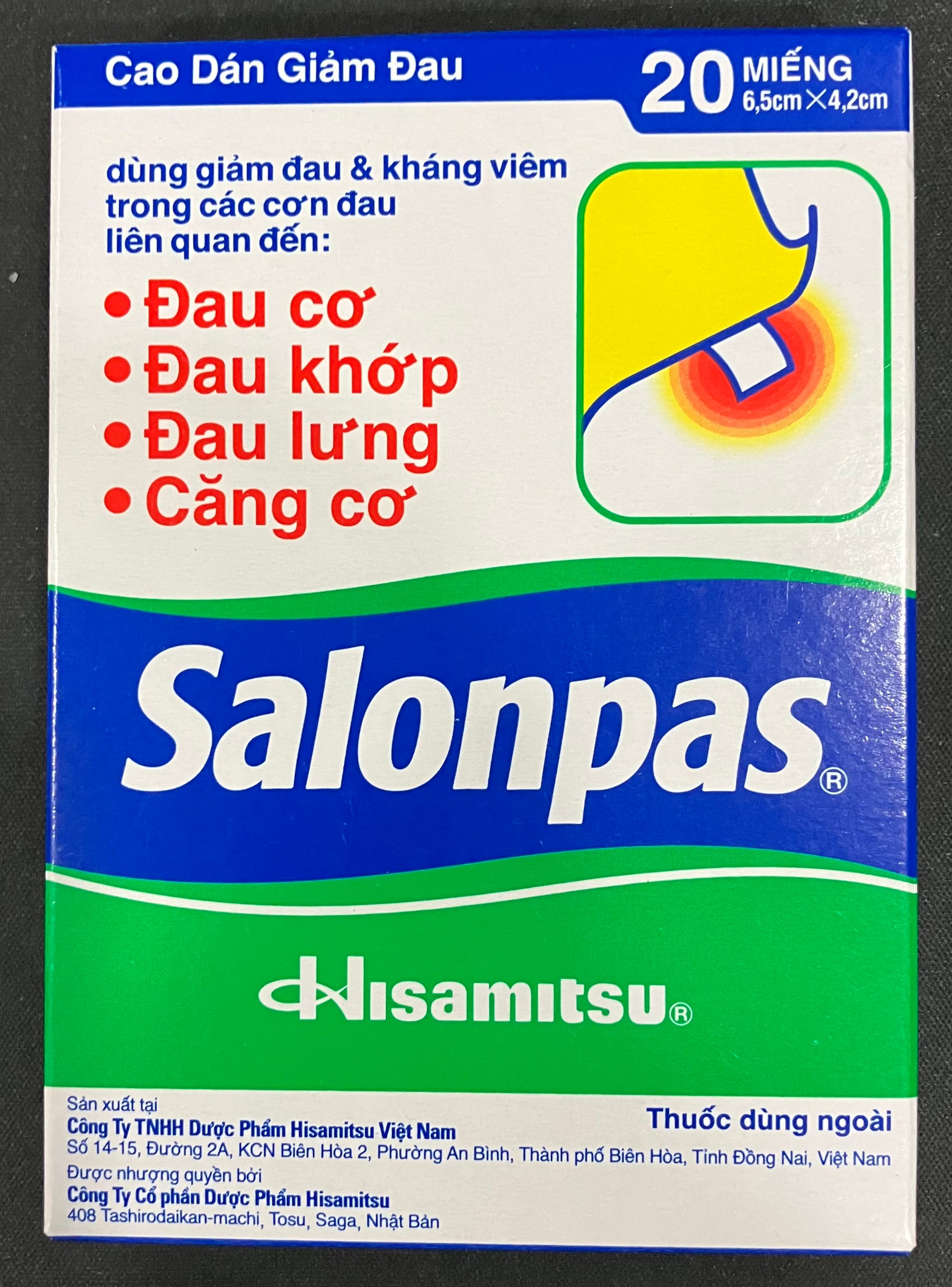
This 20-pack costs US$2.
We were out of stock, so I headed to the pharmacy. I asked the young woman behind the counter for “sa-lon-pas” with the emphasis on the second syllable. She had no clue what I was on about. So I tried again. No dice. Rather than take a chance on her getting upset with a third try, I broke out Google Translate and showed it to her (the spelling is the same, by the way). She said back to me, “sa-lon-pa” with the emphasis on the second syllable. I laughed, but I was NOT amused. What I said was the same as what she said except I had a small “z” sound at the end. There’s nothing else in the pharmacy that sounds anything like this, yet she couldn’t guess what I might’ve wanted.
Or she didn’t try ‘cause she saw my westerner mug.
Welcome to Vietnamese.
Are we having fun yet?
Tôi đau đầu!